
 繁体中文
繁体中文 简体中文
简体中文
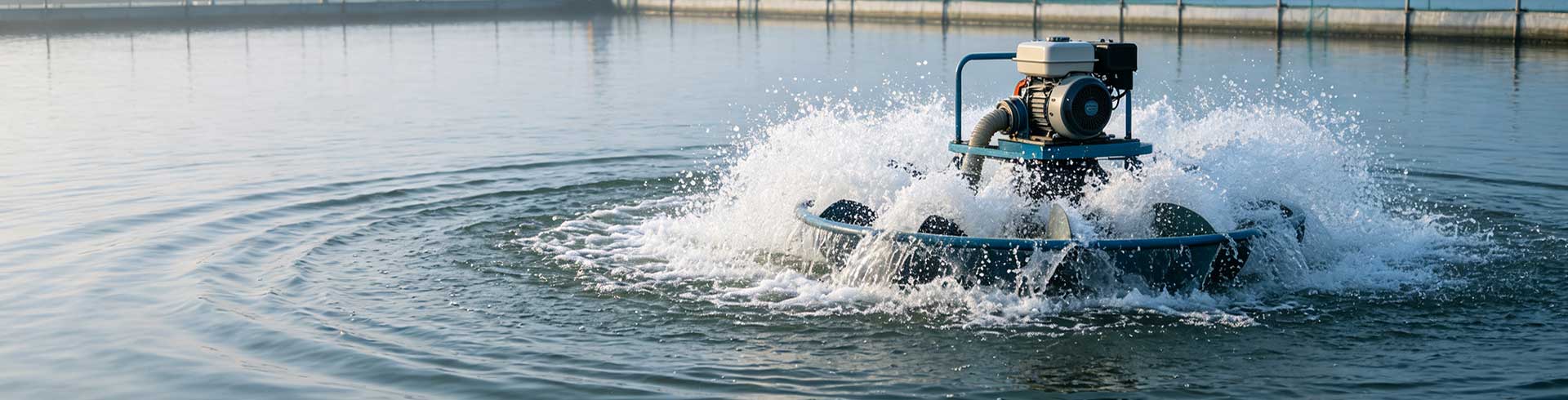

The importance and common misunderstandings of night aerators
In the aquaculture industry, the aerator is the key equipment to ensure the amount of dissolved oxygen in the water, especially at night. Due to the stop of photosynthesis, the dissolved oxygen in the water will drop sharply. At this time, the correct use of the aerator is directly related to the health and yield of the aquaculture organisms. However, many farmers have misunderstandings about turning on the aerator at night, thinking that it is fine as long as it is turned on, but it is not. This article will deeply analyze the safety points and efficiency improvement skills of turning on the aerator at night to help you manage the aquaculture water scientifically.
Why does the amount of dissolved oxygen decrease at night?
During the day, phytoplankton (algae) in the water produce oxygen through photosynthesis, which saturates or even supersaturates the amount of dissolved oxygen. But at night, photosynthesis stops, while the respiration of all aquatic organisms (including fish and shrimp, zooplankton, bacteria) continues, consuming a lot of oxygen. In addition, the decomposition of organic matter also consumes oxygen, resulting in the lowest amount of dissolved oxygen before dawn. If the aerator is not running properly at this time, it is easy to cause hypoxia floating head, or even flooding.
Common Myth: The longer the night aerator is on, the better?
Many farmers believe that the longer the oxygen machine is turned on at night, the better, or even all night. In fact, excessive oxygenation not only wastes electricity, but also may stir the sediment, release toxic substances (such as ammonia nitrogen, nitrite), and worsen the water quality. The correct way is to dynamically adjust the start time according to the amount of dissolved oxygen in the water body, rather than blindly extending it.

Guidelines for the safe operation of night aerators
Safety is the bottom line of aquaculture production. Operating an aerator at night requires particular attention to electrical safety and mechanical failure to avoid personal injury and equipment damage.
Electrical safety points
- Periodic inspection of cables
Due to the lack of light at night, cable damage is not easy to detect. It is necessary to regularly check whether the cable insulation layer is aging or damaged to prevent leakage. - Install leakage protector
The aerator must be equipped with a leakage protector to ensure its normal operation. In the event of leakage, it can automatically power off. - Waterproof and moisture-proof
Motor and junction box should be well sealed to prevent water short circuit. Heavy moisture at night requires more attention. - Avoid overloading
: Check whether the voltage is stable. If the voltage is too low, the motor will overheat and burn out. A voltage regulator should be equipped.
Machinery safety and maintenance
- Inspect impellers and bearings
The impeller is entangled by aquatic plants or debris, which will increase the load and cause the motor to overload. It should be cleaned regularly. - Lubrication maintenance
Regularly add lubricating oil to the bearing to reduce friction and prolong life. - fixed and reliable
When the wind and waves are strong at night, the aerator may shift or overturn, so ensure that the pontoon or bracket is stable. - Equipped with backup equipment
The key breeding period should have a backup aerator to prevent sudden failure at night.

Practical Tips for Improving Oxygenation Efficiency at Night
Efficiency improvement means better oxygenation under the same energy consumption, or precise control according to actual needs to reduce costs.
Scientifically determine the startup time
According to the change law of water dissolved oxygen, it usually starts to decrease in the evening, so the aerator should be turned on before sunset until photosynthesis resumes after sunrise the next day. But the specific time needs to be adjusted according to factors such as breeding density, water temperature, and weather. For example, in hot and muggy weather or continuous rainy days, the start time should be appropriately extended.
Reasonable selection of aerator type
Different types of aerators are suitable for different scenarios:
| type | feature | applicable scenario |
|---|---|---|
| Impeller aerator | Strong oxygenation capacity and large stirring area | Deep water ponds, high-density farming |
| Waterwheel aerator | Push the water to form living water | Shrimp ponds, shallow ponds |
| Microporous aeration oxygenation | Small bubbles, high oxygen dissolving efficiency | Bottom oxygenation, suitable for high density |
| Water jet aerator | It has good ornamental properties and has a cooling effect | Shallow water, landscape pond |
Night oxygenation is recommended to be used in combination, such as impeller type and microporous aeration to form upper and lower three-dimensional oxygenation.
Optimize aerator layout
The aerator should be evenly distributed to avoid dead ends. According to the shape and area of the pond, set the location reasonably so that the water flow covers the whole pool. At the same time, considering the wind direction, it is often a static wind at night, and the aerator should be used to agitate to form a circulation to promote the exchange of upper and lower water layers.
Common problems and coping strategies of nocturnal oxygenation
Blackout emergency plan
Nighttime power outages are the most feared situation for farmers, and it is crucial to have generators or battery-powered oxygenation equipment. At the same time, you can pay attention to the weather forecast in advance. In case of thunderstorms and strong winds, you should take precautions in advance.
Rapid troubleshooting of aerator failure
If the aerator suddenly stops, you should first check whether the power supply is normal, and then see if the fuse or leakage protector is tripped. If the motor heats up, it may be overload or poor heat dissipation, and it should be stopped for cooling. If there is an abnormal sound, it may be that the bearing is damaged or the impeller is rubbed, and it needs to be repaired in time.
Dissolved oxygen monitoring and automatic control
Installation of dissolved oxygen sensor and automatic controller can automatically start and stop the aerator according to real-time dissolved oxygen data, which not only ensures sufficient dissolved oxygen, but also saves electricity. This is the trend of modern farming.
conclusion
Operating an aerator at night is a link that cannot be ignored in aquaculture management, with equal emphasis on safety and efficiency. Through scientific management and meticulous maintenance, not only risks can be avoided, but also aquaculture benefits can be improved. I hope the analysis of this article can help you and take your aquaculture business to the next level.


