繁体中文
繁体中文 简体中文
简体中文
Impeller-type aerator and microporous aerator: a comprehensive comparative analysis
In aquaculture, aerators are the key equipment to ensure water quality and yield. The two most mainstream types currently on the market are impeller aerators and microporous aerators. They have their own advantages and are suitable for different aquaculture scenarios. This article will make in-depth comparisons from multiple dimensions such as working principle, aerobic efficiency, energy consumption, installation and maintenance, and applicable scenarios to help farmers make informed choices.
First, the working principle and oxygenation method
Impeller aerator
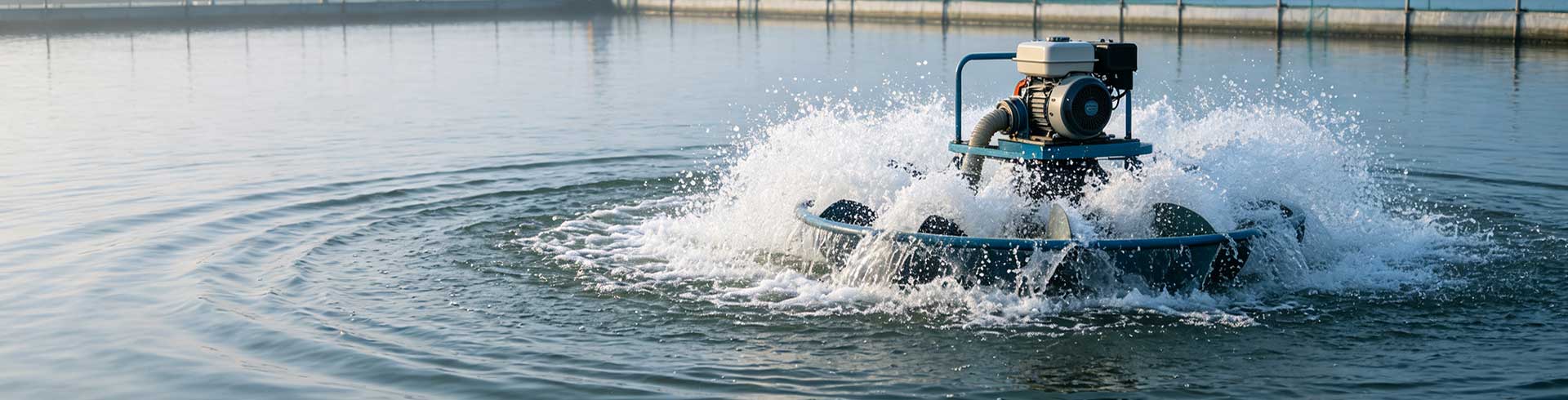
The motor drives the impeller to rotate, throwing water into the air, forming water splashes and fine water droplets, increasing the contact area between water and air, thereby dissolving oxygen in the water. At the same time, the rotation of the impeller will also stir the water body, promote the convection of the upper and lower layers of water, and achieve uniform oxygenation in the whole pool.
Microporous aerator
Then a blower is used to press air into the microporous tube or aeration plate laid at the bottom of the pool, generating tiny bubbles, which dissolve oxygen in water during the rise process. This method mainly increases oxygen at the bottom and has a significant effect on the dissolved oxygen of the bottom water.
Second, the comparison of oxygenation efficiency and effect
| comparison term |
Impeller aerator |
Microporous aerator |
|---|---|---|
| oxygenation depth |
The whole pool is uniform, but the bottom layer of dissolved oxygen rises slowly |
The bottom layer of dissolved oxygen increases rapidly, but the surface layer of oxygen increases weakly |
| Power efficiency (kgO ²/kW · h) |
About 1.5-2 |
3.0-4 (lower energy consumption) |
| Disturbance to water |
Large, suitable for farmed species that require agitation |
Small, benthic friendly |
| dead zone processing |
Multiple units need to be matched, and there are dead ends. |
Can be laid out arbitrarily, with few dead ends |
III. Energy consumption and operating costs
From an energy consumption perspective,
Microporous aerator
Usually more energy efficient. Its power efficiency is high, and the power consumption can be reduced by about 30% -50% under the same oxygen demand. Long-term operation, electricity savings are obvious. Although the impeller aerator has a large power, the equipment cost is relatively low, which is suitable for farmers with limited budgets.
IV. Installation and maintenance
Impeller aerator
The installation is simple, just fix the machine on the pontoon in the pool and connect the power supply. Maintenance is also more convenient, mainly check the motor and impeller, but pay attention to waterproof and regular lubrication.
Microporous aerator
The installation is more complicated and requires laying pipes and aeration plates, but once the installation is completed, the later maintenance is mainly to clean the aeration plate and replace the blower filter element. If the aeration plate is blocked, it will affect the oxygenation effect and needs to be checked regularly.
Applicable scenario analysis
- Impeller aerator
Suitable for: ponds with large water depths (more than 1.5 meters), ponds that need to agitate the water body to promote the decomposition of organic matter, and fish with strong aquaculture activities that require high dissolved oxygen (such as perch, mandarin). - Microporous aerator
Suitable for: ponds with shallow water depth (about 1 meter), benthic aquaculture varieties such as shrimp and crab, and intensive ponds with high water quality stability requirements.
VI. Summary of advantages and disadvantages
| type |
advantage |
disadvantage |
|---|---|---|
| impeller type |
Uniform oxygenation, both stirring function, suitable for various water depths, mature technology, moderate price |
High energy consumption, loud noise, disturbance to benthic organisms, easy to produce water splashes and cause water splashes |
| Microporous |
Energy saving and high efficiency, good oxygenation effect at the bottom, low noise, low stress on farmed animals, and can be precisely controlled |
High installation cost, troublesome maintenance, poor oxygenation effect on shallow ponds, and easy clogging of aeration trays |
Comprehensive recommendations and purchase suggestions
Let's put it all together.
There is no absolute good or bad, only whether it is appropriate
In the following cases, it is recommended to choose the impeller type:
- The budget is limited, and we hope to solve the problem of oxygenation quickly.
- Farmed fish require strong currents to stimulate growth.
- The pond is more than 1.5 meters deep and has a large area.
In the following cases, it is recommended to choose a microporous type:
- Cultivate high-value-added species, such as shrimp and crab, sea cucumbers, etc.
- Long-term operation, focusing on electricity costs.
- Insufficient dissolved oxygen at the bottom of the pond is the main problem.
In addition, it can also be used
mixed use
Strategy: During high-temperature seasons or high-density farming, turn on both aerators at the same time to give full play to their respective advantages to ensure sufficient dissolved oxygen in the whole pool.
Conclusion
Choosing an aerator requires comprehensive consideration of the breeding variety, pond conditions, capital budget and energy consumption costs. It is recommended that farmers consult professionals before purchasing, or try it on a small scale before making a decision. No matter which one you choose, regularly test the amount of dissolved oxygen in the water and manage it scientifically to achieve high yield and efficiency.