
 繁体中文
繁体中文 简体中文
简体中文
The importance of water depth selection for aerators
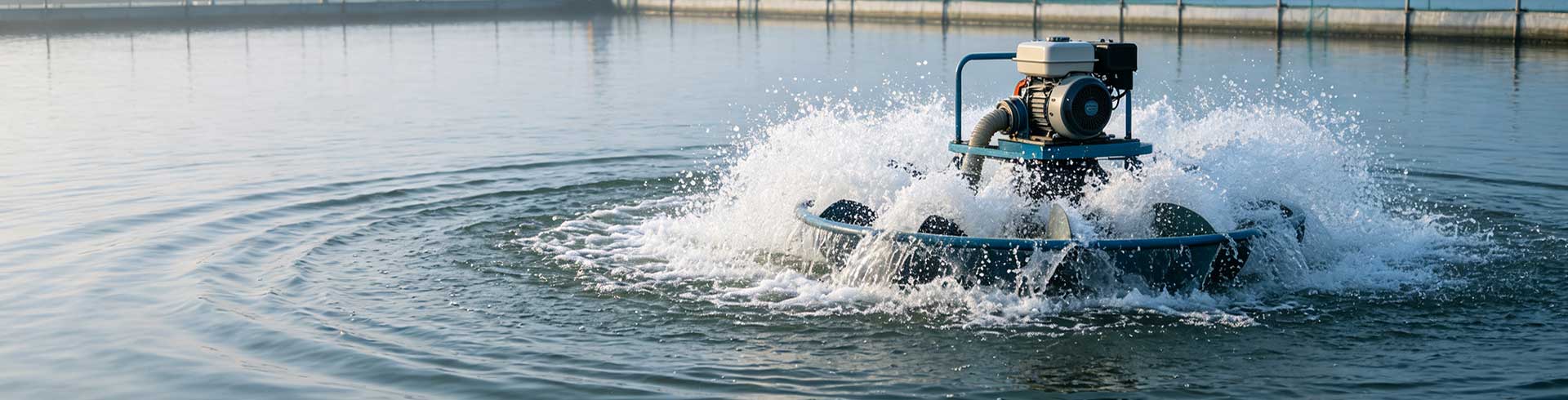
In aquaculture, the use depth of the aerator directly affects the aerobic efficiency and aquaculture benefits. Many farmers often ignore the water depth factor, resulting in poor aerobic effect, and even causing equipment damage or fish stress. This article will deeply analyze the selection, installation and use skills of aerators in deep and shallow water environments to help you scientifically increase oxygen and improve the success rate of aquaculture.
The definition and characteristics of deep and shallow water
Shallow water aquaculture (water depth 2 meters)
Deep water ponds are mostly used for adult fish farming or large lake purse seine. The water body is obviously stratified, and the bottom layer is prone to hypoxia, and the exchange between the upper and lower layers is difficult. The temperature in the deep water area is stable, but the decomposition of organic matter consumes a lot of oxygen, and the bottom layer is often in a state of hypoxia, especially in summer.
Selection of aerator under different water depths
Selection of aerator for shallow pond
- Impeller aerator
Suitable for water depth 1-1.5 meters, high power, strong water lifting capacity, but need to pay attention to shallow water over Dayee disturbance fish and shrimp. - Waterwheel aerator
Suitable for water depth 0.8-1 meters, smooth water flow, suitable for shrimp and crab breeding, will not stir the sediment. - Jet aerator
It is suitable for ponds with shallow water but need directional oxygenation, with high oxygen dissolution efficiency and low noise.
Deep water pond aerator selection
- Microporous aerator
: Suitable for water depth of more than 2 meters, through bottom aeration, can effectively solve the underlying hypoxia, and does not stir water, suitable for high-density breeding. - Swell aerator
Suitable for deep water and large surface, it can form up and down convection, break the thermocline, and promote water exchange. - Impeller aerator
(Deep water type): Increase the diameter and speed of the impeller, which can be applied to 2-3 meters of water depth, but it needs to be combined with bottom oxygenation.
Installation and use skills of aerator
Installation points for shallow ponds
- The aerator should be installed in the center or downwind of the pond to promote the circulation of the entire pool.
- The impeller aerator needs to be firmly fixed to avoid displacement due to water impact.
- When using a water wheel type aerator in shallow water areas, the angle should be adjusted to make the water flow towards the surface and avoid going straight to the bottom of the pool.
Installation points of deep-water ponds
- The microporous aeration tray should be evenly distributed at the bottom of the pool, 10-20 centimeters away from the bottom of the pool, to ensure that the bubbles cover the entire pool.
- The swell aerator can be installed in the center of the pool, using the swell to push the surface water to flow and form convection.
- In the deep water area, it is recommended to use a combined oxygenation method: impeller type + microporous aeration, taking into account the surface and bottom layers.
Influence of Water Depth on Oxygenation Effect and Misunderstandings
Myth 1: The deeper the aerator, the better
In fact, the effective oxygen depth of the aerator is limited. The impeller aerator generally has an effective water depth of no more than 2 meters, and the dissolved oxygen increase is not obvious after exceeding it. Although microporous aeration can be as deep as 5 meters, it has a large pressure loss and high energy consumption.
Myth 2: Deep-water ponds only need oxygen at the bottom
If only the bottom is oxygenated, the upper water body may be saturated with dissolved oxygen, but the lower layer is still hypoxic, and there is no disturbance of water flow, and algae are easy to age. It should be combined with surface oxygenation or surge machine to promote the circulation of the whole pool.
Practical case: different water depth oxygenation scheme
| Water depth | Cultured varieties | Recommended aerator | running time |
|---|---|---|---|
| 1 meter | Penaeus vannamei | Waterwheel + Microporous | 2H/time during the day, 6h at night |
| 1.5 meters | Grass carp | impeller type | Sunny day 2h noon, 4h at night |
| 2.5 meters | perch | Swell type + microporous | The wave machine is open during the day, and the microholes are open at night. |
| More than 3 meters | Yellow catfish | Microporous + Jet | Automatic control according to dissolved oxygen |
Summary and recommendations
The choice of aerator must be flexibly adjusted according to the water depth, breeding density, variety and season. Shallow water ponds are mainly stirred, and deep water ponds need to be combined with bottom aeration. Regularly detect dissolved oxygen, turn on the aerator in a timely manner, and avoid blind use. Scientific oxygenation can improve production and reduce risks.


